
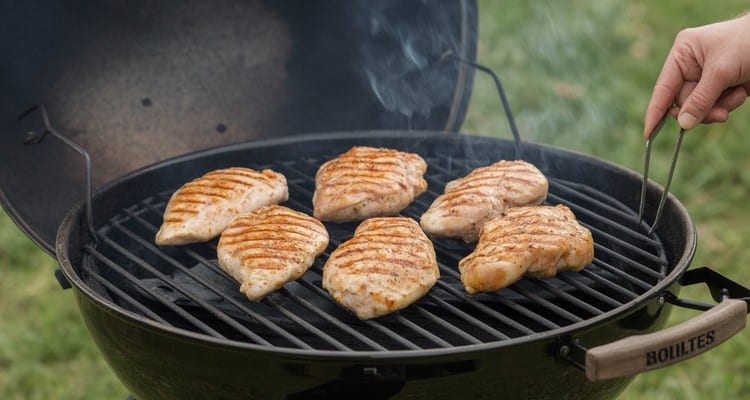
Boneless skinless chicken breast is the leanest cut on the bird, and that’s exactly why it dries out so fast on the grill. The fix isn’t complicated. With the right prep, correct grill temperature, and an instant-read thermometer, you can cook chicken breast to a juicy 165°F every time. This guide covers brining, marinades, two-zone grill setup, exact cook times, and indoor alternatives so you get moist, flavorful grilled chicken breast regardless of your equipment.
How Do You Prepare Chicken Breast for the Grill?
Proper preparation is the single biggest factor in juicy grilled chicken breast. Brining changes the protein structure to hold moisture during high-heat cooking, pounding creates even thickness for uniform doneness, and a balanced marinade adds flavor without masking the meat. Start prep 30-60 minutes before grilling for noticeable results.
Lean chicken breast has almost no intramuscular fat to keep it moist. Without preparation, the thin tail end overcooks before the thick center reaches a safe temperature. Every step below targets that problem directly.
The Importance of Brining
Brining helps chicken retain water during high-heat cooking by changing how its muscle proteins behave. Choose the method according to your available time and the surface texture you want:
| Method | Salt ratio | Refrigeration time | Best reason to use it |
|---|---|---|---|
| Wet brine | 1 tablespoon kosher salt per cup of water | 30-60 minutes, with the chicken submerged | Adds moisture quickly before grilling |
| Dry brine | 3/4 teaspoon kosher salt per pound, applied directly | 1-2 hours, uncovered | Reabsorbs seasoned surface moisture while drying the exterior for a stronger sear on the grill grates |
For most grilled chicken breasts, dry brining is the stronger choice when you have enough time for the uncovered rest.
Taking the Chill Off Before Grilling
Placing ice-cold chicken breasts straight from the refrigerator onto hot grill grates causes the muscle fibers to shock and contract, squeezing out precious moisture. Instead, let your chicken sit on the counter at room temperature for 15 to 20 minutes before grilling. This brief rest takes the chill off the meat, allowing it to cook much more evenly from edge to center and reducing the overall cooking time on the hot grates.
Pounding for Even Thickness
Most boneless skinless chicken breasts taper from about 1.5 inches at the thick end to less than half an inch at the tail. That thickness difference means the thin side finishes 5-8 minutes before the thick side. Place each breast between two sheets of plastic wrap or in a zip-top bag. Use a meat mallet or rolling pin to pound the thick end to a uniform 3/4-inch thickness. Even thickness means even cooking from edge to edge.
Grilled Chicken Breast Marinade
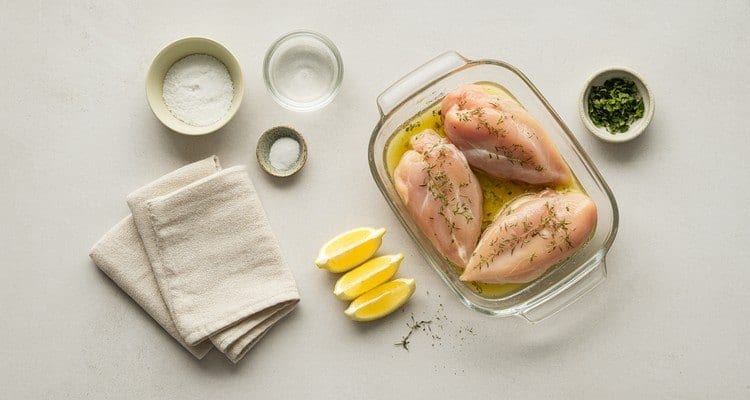
Build a balanced marinade from three components:
- Oil: Use olive oil as the base.
- Acid: Add lemon juice or vinegar at a 3:1 ratio of oil to acid.
- Aromatics and seasoning: Mix in minced garlic, fresh herbs, salt, and pepper.
Marinate the chicken in the refrigerator for 30 minutes to 2 hours. Do not exceed 2 hours with an acidic marinade because the surface can turn mushy rather than tender.
Using Mayonnaise vs. Oil to Prevent Sticking
While wiping your grill grates with oil is the traditional way to prevent sticking, many pitmasters swear by brushing a very thin layer of mayonnaise directly onto the chicken breasts before they hit the heat. Mayonnaise is an emulsion of oil and egg, which clings to the meat much better than standard cooking oil. This thin coating creates a protective barrier that prevents sticking, helps seasonings adhere, and promotes a beautifully even, golden-brown crust without altering the flavor of the chicken.
- Hotec stainless steel kitchen tongs — for easier turning and moving food
- TrendPlain oil sprayer — apply a light, even coat before grilling
- ThermoMaven bristle-free grill brush — cleans grates safely and thoroughly
- TempPro TP19H instant-read meat thermometer — check meat temperature for desired doneness
What Temperature to Grill Chicken Breast
Grill chicken breast over medium-high heat at 375-450°F using a two-zone setup. The direct-heat zone sears the outside for grill marks and flavor, while the indirect zone finishes the interior gently without burning. This temperature range cooks a 3/4-inch breast in 10-14 minutes total.
Setting Up a Gas Grill
- Preheat every burner on high with the lid closed for 10-15 minutes.
- Reduce one side to medium and leave the other on high, creating a high direct zone and a medium indirect zone.
- Clean the hot grates with a grill brush.
- Use tongs to wipe the grates with a folded paper towel lightly coated in vegetable oil.
The clean, oiled grates help the chicken release after it sears.
Setting Up a Charcoal Grill
- Light a full chimney of charcoal.
- Pour the coals onto one side of the grill and leave the other side empty to create the same two-zone arrangement as a gas grill.
- Open the bottom vents fully and set the top vent three-quarters open.
- Position the lid so the top vent sits over the indirect zone, drawing heat and smoke across the food.
Keep the empty side available whenever the chicken needs to finish away from direct flame.
Adding Wood Chips for a Touch of Smoke
Because boneless chicken breasts cook quickly, you only need a brief kiss of smoke to elevate their flavor. If you are using a two-zone setup on a charcoal or gas grill, add a small handful of mild fruitwood chips—such as apple, cherry, or pecan—directly to the hot coals or into a foil smoker packet over the active burner. Avoid heavy woods like hickory or mesquite, which can easily overwhelm the lean, delicate meat in just 10 to 15 minutes of grilling.
Step-by-Step: How to Grill Chicken Breast
Place prepared chicken breast on the direct-heat zone for 5-7 minutes per side, then move to indirect heat if the interior hasn’t reached 160°F. Pull the chicken at 160°F and rest for 5 minutes. Carryover cooking brings the final temperature to 165°F, the USDA safe minimum for poultry.
Grilling Time and Flipping Strategy
- Place the chicken presentation-side down over direct heat, close the lid, and cook for 5-7 minutes without moving it. The surface can tear if lifted before the proteins release from the grate.
- Flip once and cook the second side for another 5-7 minutes. Move the chicken to the indirect zone if flare-ups develop.
- Insert an instant-read thermometer into the thickest part. A 3/4-inch breast usually needs 10-14 minutes total.
- Pull the chicken at 160°F and rest it for 5 minutes so carryover cooking reaches the USDA-recommended safe minimum of 165°F[USDA].
Use the thermometer reading as the final decision; grill time is an estimate based on thickness and heat.
How to Achieve Restaurant-Style Crosshatch Grill Marks
To get professional, checkerboard grill marks, use the “10 and 2” rotation method. Place your chicken breasts on the direct-heat zone at a 45-degree angle (pointing toward 10 o’clock on an imaginary clock face). After 3 minutes, rotate the chicken 90 degrees so it points toward 2 o’clock, keeping it on the same side. Flip the chicken after another 3 minutes and repeat the process on the second side to achieve perfect, clean crosshatch marks.
Grilled Chicken Temperature Chart
| Breast Thickness | Grill Temp | Time Per Side | Pull Temp | Final Temp After Rest |
|---|---|---|---|---|
| 1/2 inch | 400-450°F | 3-4 min | 160°F | 165°F |
| 3/4 inch (pounded) | 375-425°F | 5-7 min | 160°F | 165°F |
| 1 inch | 375-400°F | 7-8 min | 160°F | 165°F |
| 1.5 inches (thick, unpounded) | 375°F | 8-10 min | 160°F | 165°F |
Thickness changes the estimated time, but every row uses the same 160°F pull temperature and 165°F final temperature after resting.
Always verify doneness with a meat thermometer inserted into the thickest part of the breast. Visual cues like clear juices are unreliable indicators of safe internal temperature[FSIS].

How to Grill Chicken Breast Without a Grill
You can achieve grilled-style chicken breast indoors using a cast-iron grill pan on the stove or the broiler in your oven. A preheated grill pan at medium-high heat sears the chicken in 5-7 minutes per side, while broiling at 500°F takes 6-8 minutes per side positioned 4-6 inches from the element.
How to Grill Chicken Breast on Stove
Heat a cast-iron grill pan or heavy skillet over medium-high heat for 3-5 minutes. Add a thin layer of high-smoke-point oil like avocado or vegetable oil. Place the pounded chicken breast in the pan and cook for 5-7 minutes per side. A flat, heavy meat press applied on top creates an even sear across the entire surface. Use a meat thermometer to confirm 160°F before removing from the heat.
How to Cook Chicken Breast on an Outdoor Griddle
Cooking chicken breasts on a flat-top griddle like a Blackstone is an excellent way to get an edge-to-edge golden crust. Preheat your griddle to medium-high heat (about 375°F to 400°F) and apply a thin layer of high-smoke-point oil. Place your pounded chicken breasts flat on the griddle surface and cook for 5 to 6 minutes per side. Because flat-tops offer direct contact heat, using a griddle press can help ensure even browning and speed up the cooking process.
How to Grill Chicken Breast in Oven
Set the oven broiler to high and position the rack 4-6 inches below the heating element. Place seasoned chicken breasts on a foil-lined sheet pan or broiler pan. Broil for 6-8 minutes per side, flipping once. The high, direct heat mimics the searing effect of a grill. Check with a thermometer at the thickest point and pull at 160°F. For a slower approach, bake at 425°F for 18-22 minutes. This method is less hands-on but produces less char compared to broiling or grilling.
How to Reheat Pre-Cooked Chicken Breast on the Grill
If you are warming up fully cooked or pre-cooked chicken breasts on the grill, the goal is to heat them through without drying out the already-cooked meat. Set your grill to a medium-low heat (around 300°F to 325°F) and place the chicken on the indirect-heat zone. Brush the breasts with a little chicken broth, melted butter, or BBQ sauce to add moisture, close the lid, and heat for 6 to 8 minutes, flipping once, until the internal temperature reaches 165°F.
How Should You Slice and Serve Grilled Chicken Breast?
Rest grilled chicken breast for 5 minutes, then slice against the grain into 1/2-inch strips. Resting redistributes the juices instead of letting them pool on the cutting board.
- Salads: Slice the chicken while it is still slightly warm and place it over dressed greens so the residual heat wilts them lightly.
- Wraps and grain bowls: Use the sliced chicken as a warm protein or chill it before assembly.
- Meal prep: Cool the chicken completely, divide it into airtight portions, and refrigerate for up to 4 days or freeze for up to 3 months.
- Finishing sauces: Pair it with BBQ sauce, chimichurri, or a lemon-herb drizzle. Seasoning applied before grilling supplies the flavor base; sauce at serving adds moisture and variety.

Slice only what you plan to serve immediately; intact portions retain moisture better during storage.
What Are the Most Common Mistakes When Grilling Chicken Breast?
The most common mistakes when grilling chicken breast are skipping the preheat, moving the meat too early, not using a thermometer, and cutting into the chicken to check doneness. Each of these errors leads to either dried-out chicken, torn skin, or lost juices that result in a tough, flavorless result.
- Not preheating the grill grates: Cold grates cause sticking. Preheat with the lid closed for 10-15 minutes so the grates are hot enough to sear on contact.
- Moving the chicken too soon: Chicken releases naturally from the grates after 4-5 minutes. If it tears when you try to flip, it needs more time.
- Guessing internal temperature: Color and firmness are poor indicators of doneness. An instant-read meat thermometer is the only reliable way to confirm the chicken has reached 160°F before resting.
- Skipping the rest: Cutting into the chicken immediately after grilling releases up to 30% of its juices. Rest for a full 5 minutes on a clean cutting board.
Frequently Asked Questions
How long should you cook chicken breasts on the grill?
How to cook chicken breast on the grill without drying it out?
What temperature should the grill be for chicken breast?
How often should I flip chicken on a gas grill?
Do you grill chicken breast on direct or indirect heat?
Should you brine or marinate chicken breast before grilling?
Can you grill frozen chicken breast?
How do you know when grilled chicken breast is done?
What is the best oil for grilling chicken breast?
How long does grilled chicken breast last in the fridge?
How do you reheat pre-cooked chicken breast on the grill?
To reheat pre-cooked chicken breast without drying it out, place it on the indirect-heat side of a grill preheated to 300-325°F. Brush the chicken with a little broth, butter, or BBQ sauce to replenish surface moisture. Heat for 6 to 8 minutes, flipping once, until the internal temperature reaches 165°F.
How do you grill bone-in chicken breasts?
Bone-in chicken breasts take longer to cook than boneless ones, typically requiring 30 to 40 minutes total. Start them skin-side down over direct medium heat for 5 to 10 minutes to crisp the skin, then move them to the indirect-heat zone to finish cooking. Always use a meat thermometer to ensure the thickest part near the bone reaches 165°F.
Related BBQ Guides

3-Burner Gas Grills: Perfect Options for Every Budget in 2026
Looking for the perfect 3-burner grill? We tested top gas grills from Weber, Char-Griller & more, from budget-friendly to premium options.

Kitchen Torches for Meat: Your Complete Searing Guide
Master perfect searing with our top kitchen torches for meat. Compare butane models for brisket bark, reverse sear & caramelized crusts.

Ultimate Offset Smoker Guide: Master Traditional BBQ
Discover the top 7 offset smokers tested by experts. Compare features, capacity & build quality for authentic Texas-style BBQ results.