

You pull the steak off the grill, poke it with a finger, and guess — the classic “finger test” compares firmness to your palm, but hand tension, cut thickness, and practice all skew it enough that even experienced cooks miss by a full doneness level. Then you cut it open, and it’s gray all the way through. Sound familiar? Getting steak temperature right every single time comes down to one thing: knowing the internal temps for each doneness level and hitting them precisely. This guide covers every level from rare to well-done, with a full chart, pull-off temps, visual cues, and resting guidance for maximum juiciness.
What Is the Steak Temperature Chart at a Glance?
Use this doneness chart as your quick reference every time you grill. All temperatures are the final internal temperature after resting.
| Doneness | Internal Temp (°F) | Pull Off Heat At | Color | Texture |
|---|---|---|---|---|
| Rare | 120–125°F | 115°F | Bright red center | Very soft, buttery |
| Medium-Rare | 130–135°F | 125°F | Warm red to pink center | Soft, juicy, springy |
| Medium | 140–145°F | 135°F | Pink center, brown edges | Firmer, slight chew |
| Medium-Well | 150–155°F | 145°F | Slight pink in center | Firm, noticeably drier |
| Well-Done | 160°F+ | 155°F | No pink, gray-brown | Very firm, dense |
What Are the Different Steak Doneness Levels?
Steak doneness ranges from rare to well-done, each defined by a specific internal temp. Rare and medium-rare stay juiciest. Medium-well and well-done firm up and dry out as fat renders away. Here’s what to expect at each level, plus the best cuts.
Rare Steak (120–125°F)
A rare steak has a cool-to-warm, bright red center with a thin seared crust on the outside. The interior is deeply red, very soft, and almost melts on the tongue, more like raw meat with a warm surface than a fully cooked piece of meat.
- Internal temperature: 120–125°F
- Pull off heat at: 115°F
- Color: Bright red throughout the center
- Texture: Very soft, buttery, little resistance
- Flavor: Bold, beefy, slightly metallic
- Best cuts: Filet mignon, beef tenderloin — tender cuts that can handle the near-raw texture
Rare is less common and is not recommended for ground beef, which must always reach 160°F.
Medium-Rare Steak (130–135°F)
Medium-rare is the sweet spot for most diners and what most chefs recommend. At this point, the fat in the marbling has just begun to render, flooding the meat with rich, buttery flavor. The center is warm and red fading to pink at the edges, with a firm-but-yielding bite.
- Internal temperature: 130–135°F
- Pull off heat at: 125°F
- Color: Warm red to deep pink center
- Texture: Soft, juicy, springy — ideal balance of tenderness and structure
- Flavor: Rich, beefy, with full fat rendering
- Best cuts: Ribeye, New York strip, filet mignon, T-bone, porterhouse — these well-marbled cuts shine at medium-rare
Medium-rare is the doneness level most restaurants default to. It preserves the most juice and delivers the most complex beef flavor. For thick cuts, the reverse sear method is the most reliable way to hit medium-rare edge to edge.
Medium Steak (140–145°F)
Medium steak has a pink center with more brown at the edges. Most of the fat has rendered, and it’s noticeably firmer than medium-rare. It’s slightly drier but still quite flavorful, a popular choice for those who want less pink without losing all the juiciness.
- Internal temperature: 140–145°F
- Pull off heat at: 135°F
- Color: Pink center fading to brown-gray edges
- Texture: Moderately firm, some chew
- Flavor: Less pronounced than medium-rare, slightly roasted notes
- Best cuts: Sirloin, T-bone, strip steak — cuts with moderate marbling that still deliver good flavor at this temperature
Medium-Well Steak (150–155°F)
At medium-well, only a thin sliver of pink remains in the very center of the meat. It’s noticeably firmer and drier than medium. Much of the fat has rendered out, so the flavor is more muted. Still palatable with the right prep.
- Internal temperature: 150–155°F
- Pull off heat at: 145°F
- Color: Slight pink in the very center only
- Texture: Firm, noticeably drier
- Flavor: Mild, less beefy complexity
- Best cuts: Skirt steak (marinate first), flank steak (slice thin against the grain) — cuts that are often served at medium-well in fajitas and stir-fries
Well-Done Steak (160°F+)
A well-done steak is cooked through completely, no pink, gray-brown from edge to edge. It’s very firm and dense throughout. Fat has fully rendered out, and moisture loss is significant. It’s the hardest doneness level to keep juicy, but it can be done with the right approach.
- Internal temperature: 160°F+
- Pull off heat at: 155°F
- Color: Gray-brown throughout, no pink
- Texture: Very firm, dense, dry
- Flavor: More caramelized crust notes, less interior beefiness
- Best cuts: Leaner thin-cut steaks (skirt, cube steak) — if cooking well-done, use cuts that are typically braised or marinated, and slice thin to minimize toughness
If you prefer well-done, choose well-marbled meat, cook it over lower heat to reduce moisture loss, and rest it fully before serving.
- ThermoMaven instant-read meat thermometer — confirm steak doneness quickly and accurately
- ThermoMaven wireless meat thermometer — monitor two different meat temperatures remotely
- Leave-In Probe Thermometer — monitor internal temperatures for properly cooked meats
How Do You Use a Meat Thermometer to Check Steak Doneness?
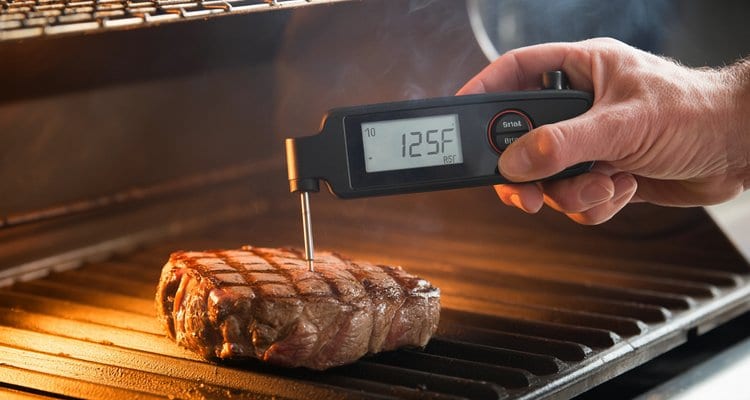
A meat thermometer is the only reliable way to nail the correct steak temperature. The finger-poke test, the timer, and cutting it open all leave too much to guesswork. Here’s how to use one correctly:
- Choose the right thermometer. An instant-read thermometer (like the ThermoWorks Thermapen or similar) gives you a reading in 2–3 seconds and is ideal for steaks. A leave-in probe thermometer works better for large roasts where you want continuous monitoring.
- Insert from the side, not the top. Push the probe horizontally through the thickest side edge of the steak, aiming for the geometric center. Inserting from the top gives you a surface reading, not a true center temp.
- Probe through and back. Push the probe all the way through to the far side, then slowly pull it back while watching the display — the lowest number you see is the true center temperature. Stopping at the first number you hit often reads a hotter spot on the way in, not the coolest point.
- Go through the thickest part. Avoid thin edges, fatty sections, and bones. The tip of the probe should be in the very center of the thickest part.
- Avoid fat pockets and bone. Fat and bone conduct heat differently than muscle. If the probe tip rests in fat, you’ll get a false high reading. If it touches bone, you may get a false reading in either direction.
- Wait for the reading to stabilize. Hold still for 2–3 seconds until the number stops climbing or fluctuating. Then check the number and pull off heat once you’ve reached your target temp.
Instant-read vs. leave-in probe thermometers
Both thermometer styles measure internal temperature, but they fit different cooking jobs. Use the comparison below to choose between a fast spot-check and continuous monitoring.
| Thermometer Type | Best For | Key Advantage |
|---|---|---|
| Instant-read thermometers | Steaks and other fast-cooking cuts | Fast readings make it easy to check doneness during a short cook. |
| Leave-in probe thermometers | Brisket, roasts, and other slower-cooking cuts | Continuous temperature monitoring without repeatedly opening the grill. |
For steak, an instant-read thermometer is the better fit. Once you have the right tool, pull the steak before it reaches its final target so carryover cooking can finish the job.
What Is Carryover Cooking, and When Should You Pull Steak Off Heat?
Carryover cooking is the process by which internal temp keeps rising after meat comes off the heat. Residual warmth trapped inside keeps cooking it for several minutes post-grill. Expect 5–10°F of carryover rise during the rest period. This means if you want medium-rare at 130°F, pull it off at 125°F and let carryover carry it the rest of the way. Why this matters: Many people hit their target on the grill, then rest it, only to find it’s overcooked when they cut in. The fix: always pull early and let carryover do the final work.
| Doneness Level | Target Final Temp | Pull Off Heat At |
|---|---|---|
| Rare | 120–125°F | 115°F |
| Medium-Rare | 130–135°F | 125°F |
| Medium | 140–145°F | 135°F |
| Medium-Well | 150–155°F | 145°F |
| Well-Done | 160°F+ | 155°F |
How Long Should You Rest Steak After Cooking?
Resting is not optional, it’s where the juiciness is won or lost. When meat hits high heat, the muscle fibers contract and push juices toward the center. Resting lets those fibers relax and reabsorb the juices throughout. Slice too soon, and those juices pour out on the board instead of staying in your dinner. How long to rest:
- Thin steaks (under 1 inch): Rest 3–5 minutes
- Standard steaks (1–1.5 inches): Rest 5–7 minutes
- Thick-cut steaks (1.5 inches or more): Rest 8–10 minutes
How to rest properly: Transfer it to a warm plate or wooden cutting board. You can loosely tent it with foil (this traps some warmth) but don’t seal it tightly or you’ll steam the crust and lose the sear. It will keep climbing 3–5°F during this rest (carryover cooking), so factor that into your pull-off temp.
How Long Should You Grill a Steak by Thickness?
Time is only a guideline — always confirm with a thermometer — but these ranges get you close for direct high heat (450–500°F), per side:
| Thickness | Rare | Medium-Rare | Medium | Well-Done |
|---|---|---|---|---|
| 3/4″ | 2 min | 2.5 min | 3 min | 4.5 min |
| 1″ | 2.5 min | 3 min | 4 min | 6 min |
| 1.5″ | 3.5 min | 4.5 min | 5.5 min | 8 min |
| 2″ | 4.5 min | 6 min | 7.5 min | 11 min |
Steaks over 1.5″ thick benefit from the reverse sear method below instead of straight direct heat, since the outside will overcook before the center catches up.
What Are the Right Temperatures for Reverse-Seared Steak?
Reverse searing means cooking low and slow first, then finishing with a hot sear — better for thick steaks and more even edge-to-edge doneness.
- Oven or smoker phase: Set to 225–250°F. Pull the steak when it reads 10–15°F below your final target (e.g., 115–120°F for medium-rare).
- Rest briefly: Let it sit 5–10 minutes while you get the sear surface screaming hot.
- Sear phase: 60–90 seconds per side over direct high heat (500°F+) just to build bark — you’re not cooking further, just browning.
- Skip the extra rest after searing: Since the low-temp phase already redistributed juices, you can slice sooner than with a direct-heat steak.
Do Specialty Cuts Like Picanha or Tri-Tip Need Different Temperatures?
The doneness temperatures themselves don’t change by cut, but fat content and grain change how a cut performs at each temperature:
- Picanha: The thick fat cap renders best in the medium-rare to medium range (130–145°F) — pulling it rarer leaves the fat cap under-rendered and chewy.
- Tri-tip: Best at medium-rare (130–135°F); this cut dries out fast past medium since it has less internal marbling than ribeye or strip.
- Flat iron: Handles medium-rare to medium (130–145°F) well thanks to even marbling, but like tri-tip gets noticeably tougher past medium.
USDA Steak Temperature Recommendation
The USDA recommends a minimum internal temperature of 145°F for whole cuts of beef (steaks, roasts, chops), followed by a 3-minute rest. This falls in the medium to medium-well range on the doneness chart. For many diners, this is higher than their preferred doneness. Here’s what to know:
- The USDA guideline is based on food safety for the general population, including vulnerable groups
- For healthy adults, medium-rare (130–135°F) is widely considered safe for whole muscle cuts like steaks, since harmful bacteria reside on the surface — which reaches safe temperatures during searing
- Ground beef is different: It must always reach 160°F, because grinding distributes surface bacteria throughout the patty
- Roasts and other beef cuts differ too: Low-and-slow roasts like prime rib or tri-tip are typically pulled 5–10°F below steak targets since they carry over more heat, while ground beef and beef dishes prepared as burgers always need 160°F regardless of doneness preference
- When in doubt — especially for children, elderly individuals, pregnant women, or anyone immunocompromised — follow the USDA’s 145°F recommendation
Frequently Asked Questions
What is the 3-3-3-3 rule for steak?
The 3-3-3-3 rule is a simple sear timing guide: 3 minutes per side on the first sear, then flip and give it another 3 minutes per side, for a roughly 1-inch steak over high heat. It’s a rough starting point for medium doneness — always confirm with a thermometer since grill heat, starting temperature, and thickness all shift the actual time needed.
Should I grill steak at 350°F or 400°F?
For a proper sear, go hotter — 450–500°F direct heat is ideal for steaks under 1.5 inches thick. 350–400°F is too low to build a real crust before the inside overcooks; that range is better suited to the low-and-slow first phase of a reverse sear on thicker cuts, not a standard direct-heat steak.
What temperature is medium-rare steak?
Medium-rare steak has a final internal temperature of 130–135°F. Pull the steak off the heat at 125°F and let carryover cooking bring it to the target range during the rest period. Medium-rare is the most popular doneness level — it delivers maximum juiciness and full fat rendering.
What temperature is well-done steak?
Well-done steak reaches an internal temperature of 160°F or higher. Pull it off the heat at 155°F. At this steak temperature, there’s no pink remaining and the meat is gray-brown throughout. Well-done is the driest doneness level, so choosing a marbled cut and resting fully helps retain what moisture remains.
What temperature is medium steak?
Medium steak has an internal temperature of 140–145°F. Remove it from heat at 135°F. The center will be pink with brown edges, and the texture is moderately firm. Medium is a good option for people who want less pink than medium-rare while retaining decent juiciness.
Is medium-rare steak safe to eat?
For healthy adults, medium-rare steak (130–135°F) is generally considered safe. Pathogens like E. coli and Salmonella reside on the surface of whole muscle cuts, and those surfaces reach safe temperatures during the sear. The USDA’s 145°F guideline is a conservative standard for broader populations. That said, always consult your own health situation and preference. Ground beef must always reach 160°F regardless.
What is carryover cooking for steak?
Carryover cooking is when a steak’s internal temperature continues to rise after being removed from heat, due to residual heat stored in the meat. Steaks typically carry over 5–10°F. This is why you pull your steak off the grill 5°F before your target temperature — it will finish cooking during the rest.
How long should I rest steak after cooking?
Rest time depends on thickness. Thin steaks (under 1 inch) need 3–5 minutes. Standard 1–1.5 inch steaks need 5–7 minutes. Thick-cut steaks 1.5 inches or more need 8–10 minutes. Resting allows muscle fibers to reabsorb juice — cutting too soon sends that juice onto the board instead of your plate.
How do I check steak doneness temperature without a thermometer?
Without a meat thermometer, you’re estimating. The most reliable non-thermometer method is the hand/finger test: compare the firmness of the steak to the fleshy part of your palm below your thumb.
- Relaxed hand = rare.
- Touch thumb to index finger = medium-rare.
- Thumb to middle finger = medium.
- Thumb to ring finger = medium-well.
- Thumb to pinky = well-done.
This is an approximation — a thermometer is always more accurate.
What is the best doneness for ribeye steak?
Ribeye is best cooked to medium-rare (130–135°F). Ribeye’s heavy marbling melts and bastes the meat from the inside at this temperature, creating extraordinary richness and juiciness. Cooking a ribeye past medium causes the fat to render out completely, leaving it drier and less flavorful.
What is the best doneness for filet mignon?
Filet mignon is best at rare to medium-rare (120–135°F). It’s an extremely lean, tender cut — cooking it beyond medium causes noticeable dryness since there’s very little fat to compensate. Medium-rare at 130–135°F is the classic choice, giving a warm red center with a luxuriously silky texture.
What is the difference between medium and medium-well steak?
Medium steak (140–145°F) has a distinctly pink center with some red tones. Medium-well (150–155°F) has only a faint sliver of pink in the very center surrounded by gray-brown meat. Medium is noticeably juicier and more tender. Medium-well is firmer and drier, with most of the fat rendered out. The 10–15°F difference is significant in texture and moisture.
Should I pull steak off heat before it reaches my target temperature?
Yes — always. Pull your steak 5°F before your target final temperature. Carryover cooking will add those final degrees during the rest period. If you wait until the thermometer hits your target before pulling, the steak will overshoot by 5–10°F and end up one doneness level above what you wanted.
Can I cook a steak well-done and still keep it juicy?
It’s difficult but possible with the right approach. Choose a well-marbled cut like ribeye — the abundant fat renders slowly and provides internal moisture longer. Cook over lower, more indirect heat rather than a raging fire to slow the moisture loss. Baste with butter during cooking. Rest fully for 8–10 minutes. Slice thin. Well-done steak will always be drier than medium-rare, but these techniques minimize the damage.
Getting Steak Temperature Right Every Time
Nailing doneness is a skill, and the foundation of that skill is mastering temperature. The charts above give you exact targets, use them every time you fire up the grill. Invest in a quality instant-read thermometer, pull it 5°F early for carryover, and always rest before you cut. Every doneness level from rare to well-done has its place, knowing the exact number for each means you’ll hit your target every single time. Ready to put this to work? See our complete steak grilling guide for technique from start to finish. For other proteins, chicken, pork, salmon, and more, see our complete internal meat temperature guide.
Related BBQ Guides

How to Smoke Eggs: Easy Recipe for Pellet Grills & Smokers
This smoked eggs recipe covers both smoking methods, wood choices, and timing so you get deep flavor and a golden color every time you fire up the smoker.
USDA Beef Grades: Select Premium Cuts for Perfect BBQ
Master USDA beef grades. Learn quality indicators, marbling scores & how to choose the best cuts for your BBQ.
Freezer Meat Storage: How Long Every Cut Actually Lasts
Find out how long does meat last in freezer storage, broken down by cut from beef to poultry, plus expert tips on preventing freezer burn and safe thawing.