

Maintaining precise temperature control during low-and-slow BBQ sessions can feel like a full-time job. One moment you're at the perfect 225°F, the next you're battling temperature swings that threaten hours of careful cooking. BBQ temperature controllers eliminate this constant vigilance by automatically regulating airflow to your smoker or grill, maintaining rock-solid temperatures for hours—even overnight. Whether you're smoking brisket, ribs, or pulled pork, these devices give you the freedom to focus on other tasks while delivering consistently exceptional results.
In this comprehensive guide, we'll explore the best BBQ temperature controllers available in 2026, helping you find the perfect automated solution for stress-free smoking.
Quick Comparison
| Controller | Connectivity | Fan Type | Probes | Best For | Where to Buy |
|---|---|---|---|---|---|
 INKBIRD ISC-027BW WiFi INKBIRD ISC-027BW WiFi
|
WiFi 2.4GHz + BT | Variable-speed | 4 | Best Overall | See at Amazon |
 Flame Boss 500-Kamado Flame Boss 500-Kamado
|
WiFi | Variable-speed | 4 | Best for Kamado | See at Amazon |
 Flame Boss 500-Universal Flame Boss 500-Universal
|
WiFi | Variable-speed | 4 | Best Versatile | See at Amazon |
 Flame Boss 400 Flame Boss 400
|
WiFi | Variable-speed | 2 | Best Budget WiFi | See at Amazon |
 BBQ Guru CyberQ WiFi BBQ Guru CyberQ WiFi
|
WiFi | On/off | 4 | Best Budget | See at Amazon |
|
BBQ Guru CyberQ Cloud
|
WiFi + Cloud | On/off | 3 | Best Cloud Features | See at Amazon |
INKBIRD ISC-027BW WiFi
5-inch color touchscreen display
Why BBQ Temperature Control Matters
The science of low-and-slow cooking demands consistent temperatures over extended periods. When smoking a brisket for 12-16 hours, temperature fluctuations of even 25-30 degrees can dramatically affect the final result. Too hot and you risk drying out the meat or rendering fat too quickly. Too cool and collagen won't break down properly, leaving you with tough, chewy results. Traditional charcoal and wood smoking requires constant attention—adjusting vents, adding fuel, monitoring weather changes. Even experienced pitmasters struggle to maintain perfect temperature stability, especially during overnight cooks or when conditions shift unexpectedly.
Automatic BBQ temperature controllers solve this problem by creating a feedback loop between temperature sensors and airflow management. These systems can deliver stability within 5-10 degrees of your target for the entire cook, regardless of fuel type or weather conditions. Beyond consistency, temperature controllers offer practical benefits that transform the smoking experience. You can sleep through overnight brisket cooks, run errands during a pork shoulder session, or entertain guests without constantly checking your pit.
For competition BBQ teams and serious enthusiasts, WiFi-enabled controllers provide real-time temperature data and alerts from anywhere, ensuring nothing goes wrong even when you're not standing beside the smoker.
How Temperature Controllers Work
At its core, a BBQ temperature controller uses three essential components: a temperature probe, a control unit with processing logic, and an air delivery system (typically a fan or damper mechanism). The temperature probe monitors your smoker's internal temperature, sending continuous readings to the control unit. This pit probe typically mounts near the cooking grate, measuring ambient temperature in the cooking chamber rather than inside the meat. Most controllers also include additional food probes to monitor internal meat temperatures simultaneously. The control unit acts as the brain of the system, making real-time decisions about airflow.
When the controller detects temperatures dropping below your target, it activates the fan to force more oxygen into the firebox, feeding the fire and raising the temperature. Once the target is reached, the fan shuts off or reduces to a maintenance level. Variable-speed fans represent a significant advancement over simple on/off blowers. Rather than blasting air at full power every time the temperature dips, variable-speed units make subtle adjustments—ramping up gradually as needed and backing off gently as temperature approaches target. This creates smoother temperature curves without the dramatic spikes from aggressive airflow changes.
Modern WiFi temperature controllers stream temperature data to smartphone apps and allow you to adjust target temperatures remotely. Cloud-based models log your entire cook, creating temperature graphs you can review later to improve your technique. Many also include open-lid detection, which prevents the fan from overreacting when you briefly open the smoker to spritz or check your food.
Types of BBQ Temperature Controllers
 Understanding the different approaches to automated temperature control helps you choose the right system for your setup. While all controllers share the same goal, they achieve it through different mechanical systems and connectivity options.
Fan-Based Controllers
Fan-based controllers are the most common type, using an electric blower to force air into your smoker's firebox. Variable-speed fans make gradual adjustments for smooth temperature curves, while simpler on/off fans cycle between full power and off. Variable-speed units generally provide tighter temperature control, but on/off fans work perfectly well for most smoking applications and often cost less.
Damper-Based Controllers
Damper-based controllers use a motorized damper or servo to open and close your cooker's air intake. Rather than forcing air in, these systems control the natural draft by adjusting the intake opening. Damper systems consume less power than fan-based units and create a more natural fire behavior. However, they work best on cookers with good natural draft and may struggle in cold or windy conditions.
WiFi vs. Bluetooth Controllers
WiFi models connect to your home network, allowing monitoring from anywhere with internet access—even miles away. Bluetooth controllers offer a shorter range (typically 100-300 feet), but provide simpler setup with a direct phone-to-controller connection. For most backyard cooks where you're staying home, Bluetooth is sufficient. WiFi becomes valuable for overnight cooks when you're sleeping elsewhere in the house, or when you need to step away during a long smoking session.
Standalone vs. Smartphone-Dependent Units
Standalone controllers include an onboard display and physical controls, functioning completely independently of smartphones. Smartphone-dependent models eliminate the display and rely entirely on app control. While the app-only approach reduces cost and simplifies the hardware, it means you need your phone nearby to check temperatures or make any adjustments. Consider whether you prefer glancing at a physical display or pulling out your phone each time you want to check on the cook.
How to Choose the Best BBQ Temperature Controller
Compatibility with Your Grill or Smoker
Before purchasing, verify the controller will work with your specific cooker. Kamado grills need controllers with appropriate mounting hardware and algorithms tuned for ceramic cookers' thermal properties. Offset smokers and cabinet smokers typically work with universal controllers, but check that the fan can deliver adequate airflow for your firebox size. Some manufacturers sell cooker-specific kits that simplify installation significantly.
Number of Probes Needed
At minimum, you need one pit probe for temperature control. Add food probes if you frequently cook multiple different meats, monitor different areas of large cuts, or want to track both meat and ambient pit temperature simultaneously. Controllers supporting 3-4 probes provide maximum flexibility for complex cooks.
WiFi, Bluetooth, or RF Wireless
WiFi provides unlimited range through your home network, ideal for overnight cooks or when you might leave home. Bluetooth offers 100-300 foot range with simpler setup and no network dependency—sufficient for most users who stay nearby. RF wireless falls between these options, offering several hundred feet of range without a WiFi network but requiring a dedicated receiver.
Fan Quality and CFM Rating
Variable-speed fans provide smoother temperature control than simple on/off models, though both approaches work effectively. Pay attention to CFM (cubic feet per minute) ratings—larger smokers and offset cookers need more airflow (12+ CFM), while kamado grills work well with smaller fans (6-10 CFM) due to their efficient design.
Build Quality and Weather Resistance
Controllers live outdoors exposed to heat, smoke, and weather. Look for sealed electronics, weather-resistant housings, and high-temperature probes rated well above your maximum cooking temperature. Fan units should include screens to prevent debris from entering the blower mechanism. Quality controllers last for years of regular use.
App Features and Usability
If you're investing in WiFi or Bluetooth connectivity, evaluate the companion app carefully. Look for intuitive interfaces, reliable connectivity, temperature graphing, customizable alerts, and data logging. Reading user reviews specifically about app stability can reveal problems not apparent from marketing materials.
Installation and Mounting Options
Consider how the controller attaches to your specific cooker. Some require drilling or permanent modification, while others use clamps or adapters that install tool-free. Universal controllers should include multiple mounting options to accommodate different vent configurations. Kamado-specific units typically install in minutes using the included hardware designed for standard bottom vent sizes.
Product Reviews
INKBIRD ISC-027BW WiFi
- 5-inch color touchscreen display
- Variable-speed fan with automatic and manual modes
- WiFi connectivity (2.4GHz)
- Supports up to 4 probes total (1 pit, 3 food)
- Rechargeable battery with long runtime
- Magnetic back for mounting on metal surfaces
The INKBIRD ISC-027BW offers impressive value by packing WiFi connectivity, variable-speed fan control, and a full-color touchscreen into an affordably-priced package. It delivers features typically found on more expensive models while maintaining reliable performance. The 5-inch color touchscreen shows all critical information at a glance—pit temperature, food temperatures, target settings, and fan status. You can also manage everything through the smartphone app when you're away from the smoker.
INKBIRD's variable-speed fan makes smooth adjustments to maintain steady temperatures. The controller ramps up when recovering from a lid-open event and backs off gently as temperature approaches target. The fan operates in either automatic mode or a fixed manual speed. The ISC-027BW supports up to three additional food probes beyond the included pit probe, making it suitable for complex multi-item cooks. WiFi connectivity works reliably with 2.4GHz networks, and the app provides temperature graphs, custom alerts, and remote control from anywhere.
See at AmazonFlame Boss 500-Kamado
- Large 4-line backlit LCD display
- WiFi-enabled with Cloud, Local, and Direct modes
- Supports up to 4 probes (1 pit, 3 meat)
- Variable-speed fan tuned for kamado grills
- Automatic Learning PID controller for precision
- Voice command support via Amazon Alexa and Google Home
The Flame Boss 500-Kamado is a top-tier WiFi controller that brings pellet-grill convenience to charcoal-fired ceramic cookers. It uses an automatic learning PID controller to maintain oven-like temperature precision, making it a true 'set-it-and-forget-it' solution. The large backlit LCD screen and on-device controls allow for full operation without relying on a smartphone, a key advantage over screenless models. With three connectivity modes—Cloud, Local WiFi, and Direct—you can monitor your cook from anywhere.
Designed specifically for kamado grills, the kit includes a variable-speed blower and adapters for all major brands like Big Green Egg and Kamado Joe. It supports up to four probes (one pit, three meat), allowing you to monitor multiple items or different parts of a large cut. Voice command integration with Amazon Alexa and Google Home adds another layer of hands-free convenience.
See at AmazonFlame Boss 500-Universal
- Compatible with drum, barrel, cabinet, and offset smokers
- Powerful 45 CFM variable-speed blower for large cookers
- Four probe ports for comprehensive monitoring
- WiFi with Cloud, Local, and Direct modes
- Voice assistant integration (Alexa/Google Assistant)
- Full control available on the physical unit
The Flame Boss 500-Universal is a premium choice for pitmasters who need to control larger charcoal smokers like offsets, drums, and cabinets. Its powerful 45 CFM variable-speed blower can manage the airflow required for bigger fireboxes, delivering the same 'set-it-and-forget-it' precision as its kamado-focused counterpart. Like other 500-series models, it offers a physical LCD interface for full on-device control, multiple WiFi modes for flexible connectivity, and support for up to four probes.
The universal kit includes a versatile manifold and mounting adapters to fit a wide range of smokers, including the Weber Smokey Mountain. With its robust blower and multi-probe capacity, the 500-Universal is built for serious, large-scale barbecue.
See at AmazonFlame Boss 400
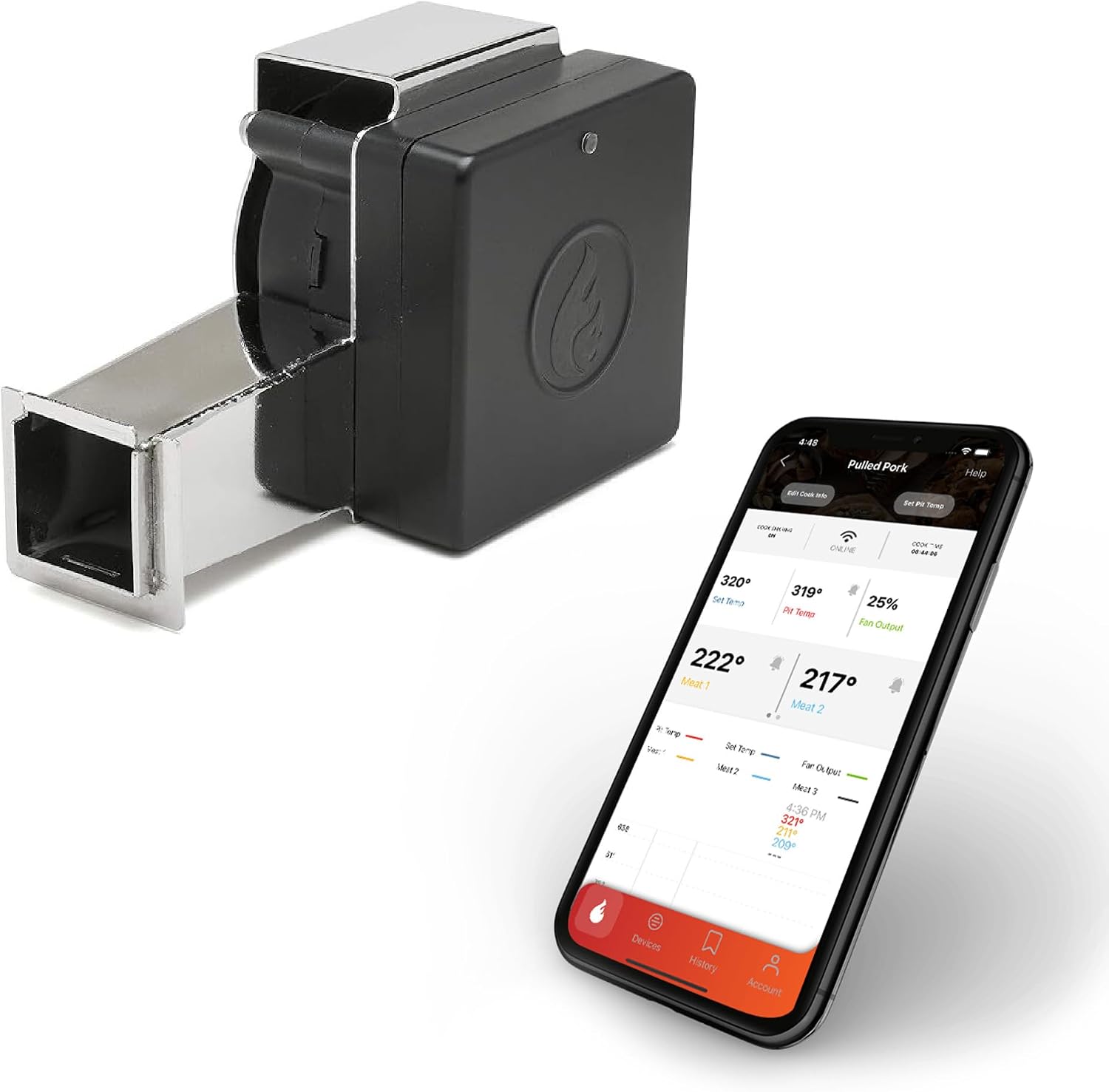
- Integrated all-in-one design (controller is built into the fan)
- App-based control via WiFi (iOS and Android)
- Supports voice commands with Alexa and Google Home
- Cloud monitoring with temperature graphs
- Automatic 'Keep Warm' mode
- More affordable than models with built-in screens
The Flame Boss 400 offers the core precision of the Flame Boss ecosystem in a more compact and affordable package. By integrating the controller directly into the blower unit and relying on a smartphone app for all controls, it eliminates the need for a separate display box. This streamlined design makes it a great budget-friendly entry into WiFi temperature control.
Despite its smaller size, the 400 still features a variable-speed fan, cloud connectivity for remote monitoring, and voice assistant support. It's a capable and reliable choice for overnight cooks, automatically adjusting airflow to hold your target temperature. While it supports only one meat probe and lacks on-device controls, its performance and ease of use make it an excellent value.
See at AmazonBBQ Guru CyberQ WiFi
- Supports up to 4 probes (1 pit, 3 food)
- WiFi with Ad-Hoc and Infrastructure modes
- Ramp Mode prevents overcooking food
- Open Lid Detection pauses fan to avoid temperature spikes
- Adaptive Control algorithm learns your smoker's behavior
- Proven, rock-solid performance over many years
The BBQ Guru CyberQ WiFi is a legendary workhorse in the world of temperature controllers. While it's an older model, its performance and precision remain benchmarks for reliability. The CyberQ supports up to three food probes in addition to the pit probe, making it ideal for large cooks. Its web interface and on-device LCD provide full control without relying on a modern smartphone app.
Advanced features like Ramp Mode, which lowers the pit temperature as food nears doneness, and Open Lid Detection, which prevents flare-ups, set the CyberQ apart. Its adaptive control algorithm learns the specific thermal properties of your smoker over time, delivering increasingly precise temperature management. For pitmasters who value proven reliability over a slick app, the CyberQ WiFi is a fantastic choice.
See at AmazonBBQ Guru CyberQ Cloud
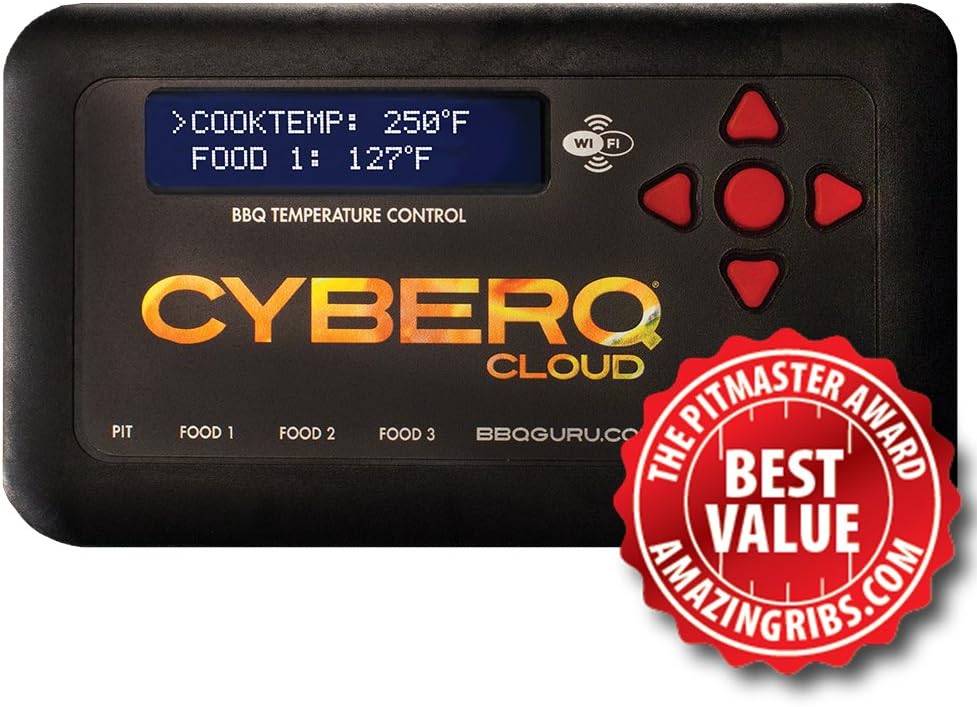
- Automatic cloud data logging of all cooks
- Web browser access to temperature data and graphs
- Supports up to 3 probes (pit plus two food)
- Smart Cook mode adapts to cooker type
- Ramp mode prevents overcooking
- Share cook data with friends or community
The BBQ Guru CyberQ Cloud builds on the CyberQ WiFi foundation with stronger cloud connectivity and cook logging. It saves each session to BBQ Guru's cloud servers, giving you temperature graphs for pit temperature, food temperature, and fan activity that you can review later when repeating a successful cook.
Ramp mode and Smart Cook settings help tailor the controller to your cooker, whether it is a ceramic kamado or a thinner cabinet smoker. The CyberQ Cloud supports three food probes, displays readings on the LCD, and sends data to the cloud for remote access through the app or web dashboard.
See at AmazonA Few More Buying Considerations
More advanced controllers use adaptive (PID) algorithms that learn how your specific smoker responds to fan adjustments over several cooks, tightening temperature swings instead of just reacting to them. Some higher-end models also support automation rules that bump the pit temperature once a meat probe crosses a set threshold — useful for pushing through a stall without manually adjusting the setpoint at 3 a.m.
Whatever unit you choose, route the fan and probe cables away from foot traffic and hot surfaces — a few controllers now include magnetic mounts specifically to keep cables off the ground near an open firebox, which matters more for safety than any spec sheet number.
On an offset smoker, place the ambient probe near the far end of the cooking chamber (away from the firebox) since that's typically the coolest point and the one you actually want the controller regulating to, and mount the fan on the firebox's intake damper rather than relying on the stock exhaust stack alone.
Do BBQ temperature controllers work on all smokers and grills?
Most BBQ temperature controllers work with charcoal smokers, kettle grills, kamado grills, and offset smokers—essentially any cooker that uses solid fuel and has adjustable air vents. They are not designed for gas grills, as those regulate temperature through burner output rather than airflow. Pellet grills have their own built-in temperature control systems and typically don't need a separate controller. Always check compatibility with your specific cooker model before purchasing, as kamado grills in particular often require dedicated mounting adapters.
How accurate are BBQ temperature controllers?
Quality BBQ temperature controllers can maintain pit temperatures within 5-10 degrees of your target setting under normal conditions. Factors that affect accuracy include ambient weather conditions, the quality and placement of the pit probe, fuel load, and how well-sealed your cooker is. Variable-speed fan controllers generally deliver tighter accuracy than simple on/off models. Heavily insulated cookers like kamado grills also tend to hold temperature more stably than thin-walled offset smokers.
Do I need WiFi connectivity in a BBQ temperature controller?
WiFi is a convenience feature, not a necessity. If you plan to stay home and within Bluetooth range during your cooks, a Bluetooth-only model is perfectly capable. WiFi becomes genuinely useful for overnight cooks where you want to monitor temperatures from your bedroom, or for situations where you might need to step away during a long smoke. Cloud-connected models add the additional benefit of permanent cook logging. For most backyard enthusiasts, a mid-range WiFi unit provides the best balance of capability and peace of mind.
Will a temperature controller help with overnight BBQ cooks?
Yes—overnight cooks are where BBQ temperature controllers deliver the most value. Once your smoker is loaded, lit, and dialed in to your target temperature, a WiFi-connected controller will maintain that temperature through the night. Set upper and lower temperature alarms so your phone alerts you if anything goes wrong. Many experienced pitmasters consider a controller non-negotiable for overnight brisket or pork butt cooks. Ensure your smoker has enough fuel loaded before sleeping. A controller can maintain temperature, but it can't add charcoal for you.
How do I install a BBQ temperature controller on my smoker?
Most fan-based controllers mount over the bottom intake vent using an included adapter plate. The adapter plate is secured with clamps or existing hardware—no drilling required in most cases. The fan unit attaches to the plate, and the pit probe threads through a small hole or existing port into the cooking chamber. Kamado grills often include dedicated adapter sizes for standard bottom vent configurations. The process typically takes 10-15 minutes, and most controllers include illustrated instructions for common cooker types.
Does using a temperature controller affect fuel consumption?
Temperature controllers typically improve fuel efficiency compared to traditional vent management. Because the fan makes small, precise adjustments rather than leaving vents wide open, the fire burns more consistently and at a controlled rate. You'll avoid the fuel waste that comes with temperature spikes caused by too much airflow, and the more efficient burn means your charcoal load lasts longer. For very long cooks, it's still important to load enough charcoal before you start—a controller can't add fuel for you.
The Verdict
Related BBQ Guides
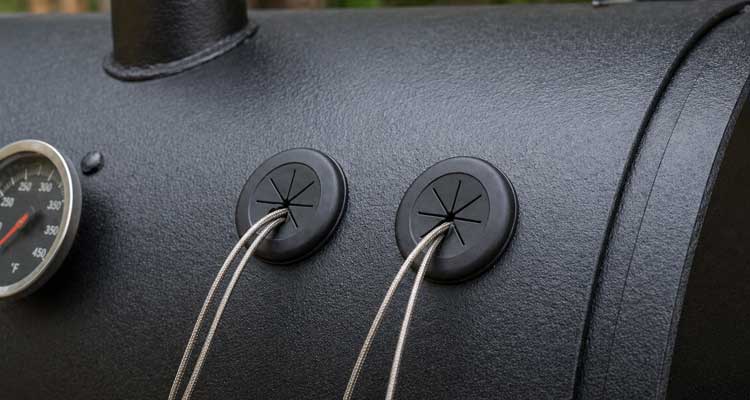
Top Probe Port Grommets for Smokers: A Perfect Seal
Discover the best probe port grommets for smokers to maintain a perfect seal and protect your cables. We review top-rated silicone ports for 2026.

How to Grill Fish Without Sticking or Falling Apart
Learn how to grill fish with clean grates, proper oiling, direct heat, foil packets, and safe 145°F doneness checks for flaky backyard results.

Essential Charcoal Grill Accessories for Flawless Results
Discover the best charcoal grill accessories for 2026. Our expert guide covers top-rated tools for faster lighting, safer cleaning, and perfect results.