
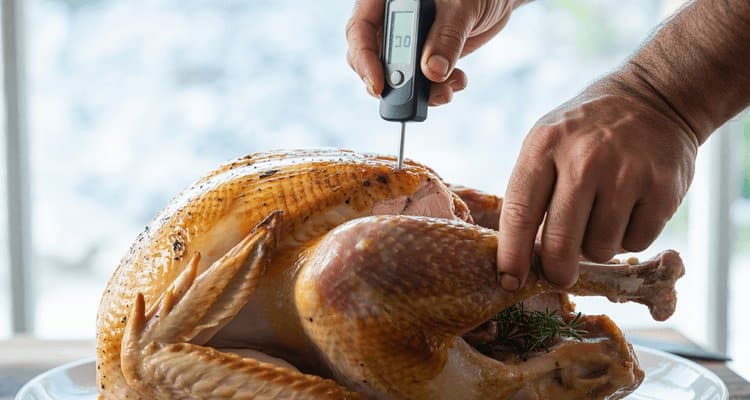
The difference between dry, sawdust-textured turkey and juicy, tender perfection comes down to one critical factor: temperature accuracy. While millions of home cooks rely on those little plastic pop-up timers that come pre-inserted in store-bought turkeys, these convenient indicators are actually sabotaging your Thanksgiving dinner.
Pop-up timers are calibrated to trigger at 180-185°F—a temperature so high that your turkey breast has already crossed into the overcooked danger zone by the time that red stem pops up.
Quick Comparison
| Thermometer | Type | Response Time | Best For | Where to Buy |
|---|---|---|---|---|
 ThermoPro TP03B Digital Instant-Read Thermometer – Best Budget Digital ThermoPro TP03B Digital Instant-Read Thermometer – Best Budget Digital
|
Digital Instant-Read | 3-4 seconds | Budget Digital | See at Amazon |
 ThermoPro TP20 500FT Wireless Meat Thermometer – Best Leave-In Wireless ThermoPro TP20 500FT Wireless Meat Thermometer – Best Leave-In Wireless
|
Leave-In Wireless | Continuous | Leave-In Wireless | See at Amazon |
 EIHO Digital Instant Read Meat Thermometer – Best Smart Wireless EIHO Digital Instant Read Meat Thermometer – Best Smart Wireless
|
Smart Wireless | 2-3 seconds | Smart Wireless | See at Amazon |
 Lavatools Javelin PRO Duo Ambidextrous Backlit Professional Digital Instant Read Meat Thermometer – Best Premium Instant-Read Lavatools Javelin PRO Duo Ambidextrous Backlit Professional Digital Instant Read Meat Thermometer – Best Premium Instant-Read
|
Premium Instant-Read | 2-3 seconds | Premium Instant-Read | See at Amazon |
 Alpha Grillers Digital Meat Thermometer – Best Value Instant-Read Alpha Grillers Digital Meat Thermometer – Best Value Instant-Read
|
Value Instant-Read | 1-2 seconds | Value Instant-Read | See at Amazon |
ThermoPro TP03B Digital Instant-Read Thermometer – Best Budget Digital
Ultra-fast 3-4 second readings eliminate guesswork
Why Pop-Up Timers Don’t Work
If you’ve ever carved into a Thanksgiving turkey only to find dry, stringy breast meat, you can probably thank that innocent-looking pop-up timer.
Here’s the problem: these spring-loaded plastic indicators are manufactured to trigger at temperatures between 180°F and 185°F. While this temperature range might have made sense decades ago when food safety guidelines were more conservative, modern USDA standards confirm that poultry is perfectly safe to eat at 165°F.
That 15-20 degree difference is enormous when it comes to meat texture and moisture retention. By the time your pop-up timer pops at 180°F, the proteins in the breast meat have contracted so tightly that they’ve squeezed out most of their natural juices.
Consumer Reports has consistently advised against relying on pop-up timers. Even Butterball—the company that pioneered these timers in the 1960s—now recommends verifying doneness with an actual meat thermometer.
The better alternative is a quality meat thermometer that gives you complete control over the exact temperature. With an accurate thermometer, you can pull your turkey from the oven at precisely 165°F, ensuring every bite is juicy, tender, and perfectly cooked.
Types of Meat Thermometers for Turkey
Before diving into specific product recommendations, it’s helpful to understand the main categories of meat thermometers and how each type excels in different cooking scenarios.
Digital instant-read thermometers are the Swiss Army knives of the thermometer world—portable, fast, and incredibly versatile. The main advantage is speed and convenience, allowing you to quickly check multiple spots on your turkey. The tradeoff is that you need to open your oven door each time you want a reading, which releases heat and can extend cooking time slightly.
Probe-style leave-in thermometers consist of a metal probe connected to a display unit via a long heat-resistant wire. You insert the probe into your turkey before it goes into the oven, route the wire out through the oven door, and the external display shows real-time temperature updates throughout the entire cook. The biggest advantage is continuous monitoring without opening the oven door.
Wireless smart thermometers represent the cutting edge of temperature monitoring technology. They’re completely wire-free—the probe stays inside your turkey while transmitting temperature data via Bluetooth to a smartphone app or standalone base station. The app provides real-time temperature graphs, estimated finish times, and push notifications when your turkey reaches the target temperature.
Product Reviews
- Ultra-fast 3-4 second readings eliminate guesswork
- Backlit display provides clear visibility in low-light conditions
- 4.5-inch probe reaches deep into large turkeys
- IPX6 waterproof rating allows easy cleaning
- Magnetic back and hanging hole offer convenient storage
- Auto-off feature extends battery life significantly
The ThermoPro TP03B delivers professional-grade accuracy at an entry-level price point. This ultra-fast instant-read thermometer provides temperature readings in just 3-4 seconds, making it perfect for quick spot-checks during the hectic Thanksgiving rush. The foldable 4.5-inch probe is long enough to reach the deepest parts of even the largest turkeys, while the backlit display ensures you can read temperatures clearly in dim kitchen lighting.
At under $15, this thermometer delivers accuracy within ┬▒0.9°F and covers a wide temperature range from -58°F to 572°F. The IPX6 waterproof rating means you can rinse it under the faucet for easy cleaning.
See at AmazonThermoPro TP20 500FT Wireless Meat Thermometer – Best Leave-In Wireless
- 500-foot wireless range for whole-home monitoring
- Dual probe system monitors meat and oven temperature simultaneously
- USDA preset temperatures for 10 meat types
- Probe wires withstand up to 716°F
- Large backlit LCD displays on both transmitter and receiver
The ThermoPro TP20 combines exceptional wireless range with dual-probe monitoring for complete temperature control. With an impressive 500-foot wireless range, you can monitor your turkey from anywhere in your home—no smartphone or app required. The standout feature is the dual probe system that lets you monitor both your turkey’s internal temperature and the oven ambient temperature simultaneously. This means you can track whether your oven is holding steady while watching your bird approach the perfect doneness.
See at AmazonEIHO Digital Instant Read Meat Thermometer – Best Smart Wireless
- 2-3 second response time for fast temperature readings
- Wide range from -58°F to 572°F covers all cooking applications
- Large backlit LCD readable in low-light conditions
- Waterproof design for easy cleaning under running water
- Built-in meat temperature reference chart on the body
The EIHO Digital Instant Read Meat Thermometer is a versatile digital thermometer that combines fast readings with a waterproof design for reliable performance in any cooking environment. With a 2-3 second response time and a wide temperature range from -58°F to 572°F, it handles everything from checking ice baths to monitoring deep fryer oil. The foldable probe design automatically powers the unit on when opened and off when closed, eliminating the need to fumble with buttons while juggling tongs and platters.
The large backlit LCD display provides clear readings even during nighttime grilling sessions, and the long probe keeps your hands safely away from heat sources. A built-in temperature reference chart printed on the body shows USDA-recommended temperatures for different meat types, making it a practical tool for cooks who are still learning their target temperatures.
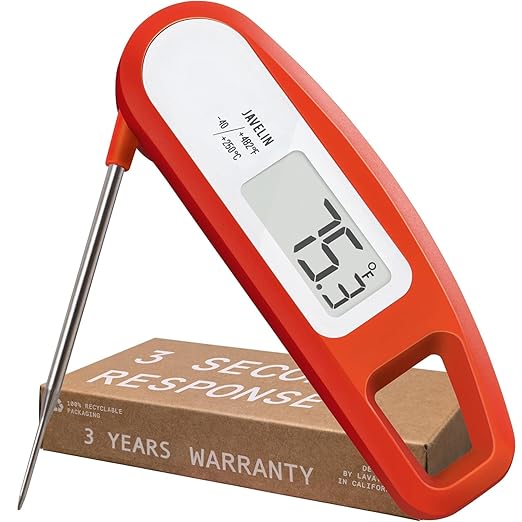
See at AmazonLavatools Javelin PRO Duo Ambidextrous Backlit Professional Digital Instant Read Meat Thermometer – Best Premium Instant-Read
- Ultra-fast 2-3 second response time for instant readings
- Anti-bacterial BioCote coating reduces bacteria by 99.99%
- Ambidextrous rotating display automatically orients for easy reading
- IP65 splash-proof rating withstands harsh kitchen environments
- 4,000+ hour battery life with aggressive auto-sleep mode
- Stabilizing beveled edge prevents rolling when set down
- Large backlit display readable in all lighting conditions
The Lavatools Javelin PRO Duo represents the pinnacle of instant-read thermometer technology. This professional-grade instrument delivers temperature readings in just 2-3 seconds—faster than any other thermometer in its class. The anti-bacterial BioCote coating on the probe reduces bacteria growth by 99.99%, making it ideal for busy kitchens where cross-contamination risks run high. The ambidextrous rotating display automatically orients itself for easy reading regardless of which hand you're using or the angle at which you're holding the thermometer.
The military-grade IP65 splash-proof design means you can use it in any kitchen environment.
See at Amazon
- Ultra-fast 1-2 second response time
- IP67 water-resistant—rinse under running water
- Bright blue backlit display for any lighting condition
- Pre-calibrated with easy recalibration feature
- Includes meat temperature chart for perfect results
- Elegant gift box packaging
The Alpha Grillers Digital Meat Thermometer delivers exceptional performance at an unbeatable price point. With lightning-fast 1-2 second readings and IP67 water resistance, this thermometer punches well above its weight class. What makes the Alpha Grillers stand out is its combination of professional features at a budget-friendly price. The bright blue backlit display is easy to read whether you're grilling in the dark or working in a steamy kitchen.
Pre-calibrated at the factory with easy recalibration capability, this thermometer comes with a handy meat temperature chart that helps beginners nail perfect doneness every time. It's an ideal choice for those who want reliability without breaking the bank.
See at AmazonWhere to Insert a Meat Thermometer in Turkey
Proper thermometer placement is just as important as choosing the right thermometer. Insert it in the wrong spot, and you’ll get inaccurate readings that lead to undercooked or overcooked meat.
The breast is the first place to check because white meat cooks faster than dark meat and is more prone to drying out.
Insert your thermometer into the thickest part of the breast, aiming for the center of the muscle mass. Insert the probe from the side of the breast, not from the top, angling it horizontally parallel to the cutting board.
Make sure the probe doesn’t touch bone—if you feel hard resistance, back out and adjust your angle. For instant-read thermometers, ensure the entire sensor area (typically the first 1-2 inches of the probe tip) is fully inserted into the meat.
The target temperature for turkey breast is 165°F for food safety. However, many professional chefs pull the breast at 160°F and allow carryover cooking during the resting period to bring it up to 165°F.
Dark meat benefits from slightly higher temperatures than white meat. The connective tissue in thighs breaks down more completely at higher temps, resulting in more tender, flavorful meat.
Insert the probe from the top of the thigh, aiming downward at an angle. Push the probe into the thickest part of the thigh muscle (usually the inner thigh area). Avoid the bone—thigh bones are large and easy to hit, but touching bone will give false readings.
The ideal temperature for turkey thighs is 170-175°F. At this temperature range, the collagen in the connective tissue has fully broken down, creating rich, tender meat.
Don’t assume both sides of your turkey are cooking at the same rate. Oven hot spots, uneven heat distribution, and positioning can cause one side to cook faster than the other.
Always check both breasts and both thighs—your turkey isn’t done until the coolest spot reaches the target temperature.
Understanding Turkey Temperature Zones
Not all parts of your turkey cook at the same rate, and different cuts actually benefit from different target temperatures.
Turkey breast is lean, with minimal fat content and no connective tissue to break down. This means it cooks relatively quickly and becomes dry if overcooked.
The USDA safe minimum temperature is 165°F, but most professional chefs pull the breast at 160°F and rely on carryover cooking during the resting period to bring it up to 165°F.
This technique results in noticeably juicier meat. During the 20-30 minute resting period, the internal temperature will continue to rise 5-7 degrees.
Thighs and drumsticks contain significantly more fat and connective tissue than breast meat. This connective tissue (collagen) needs to reach higher temperatures to break down properly.
While dark meat is technically safe to eat at 165°F, it will be tough and chewy at that temperature because the collagen hasn’t fully converted to gelatin.
For the most tender, flavorful dark meat, target 170-175°F. At these temperatures, the collagen breaks down completely, the meat becomes fall-off-the-bone tender, and the extra fat keeps everything moist and rich.
The Science of Carryover Cooking
Carryover cooking is one of the most important concepts in meat preparation, yet it’s often overlooked by home cooks.
Understanding and leveraging carryover cooking is the difference between good turkey and exceptional turkey.
Carryover cooking refers to the phenomenon where meat continues to cook even after it’s been removed from the heat source. When you pull your turkey from the oven, the outer layers are significantly hotter than the interior.
During the resting period, this heat continues to penetrate inward, raising the internal temperature by 5-10°F depending on the size of the bird.
Professional chefs use carryover cooking to their advantage by pulling meat at slightly lower temperatures than the target. Here’s how to apply this technique to turkey:
- Remove turkey when breast reaches 160°F (not 165°F)
- Tent loosely with foil to retain some heat without trapping too much steam
- Rest for 20-30 minutes on a quality carving board or serving platter
- Verify final temperature before carving: Breast should read 165-167°F after resting
This technique ensures your breast meat reaches the safe 165°F minimum without overcooking.
The result is noticeably juicier, more tender white meat that doesn’t require drowning in gravy.
Pro Tips for Accurate Readings
These advanced techniques help you get professional-level results with any thermometer.
Bones conduct heat faster than meat, so if your probe touches bone, you’ll get a reading that’s 5-10°F higher than the actual meat temperature. This is the single most common cause of undercooked turkey.
When inserting your probe, aim for the center of muscle tissue and angle away from the skeleton. If you feel hard resistance, you’ve hit bone—back out and adjust your angle.
Your turkey doesn’t cook evenly. One breast may be 5 degrees hotter than the other due to oven hot spots. The thighs cook more slowly than the breast.
Always check at least four locations: both breasts and both thighs. Your turkey isn’t done until the coolest spot reaches your target temperature.
Even expensive thermometers can lose accuracy over time. Calibrate your thermometer at the beginning of each cooking season using the ice water test or boiling water test.
This 2-minute check ensures your readings are accurate and prevents both undercooking and overcooking.
Ice Water Test:
- Fill a glass with ice and add cold water
- Stir and let sit for 1 minute
- Insert thermometer probe into the ice water (not touching sides or bottom)
- Reading should be 32°F (±2°F)
- If off by more than 2°F, recalibrate according to manufacturer instructions
Pull your turkey when the breast reaches 160°F, not 165°F. During the 20-30 minute resting period, carryover cooking will bring the internal temperature up to 165-167°F.
This prevents overcooking and results in significantly juicier meat. This is how professional chefs achieve restaurant-quality results at home.
For a full comparison of wireless meat thermometer options, see our wireless meat thermometer guide.
What temperature should turkey be when it’s done?
The USDA recommends a minimum internal temperature of 165°F for all parts of the turkey. However, many professional chefs pull the breast at 160°F and allow carryover cooking during the 20-30 minute rest to bring it up to 165°F. Dark meat (thighs and drumsticks) tastes best at 170-175°F, where the collagen has fully broken down into tender gelatin.
Where is the best place to put a thermometer in a turkey?
Insert your thermometer into the thickest part of the breast from the side, angling horizontally parallel to the cutting board. Also check the inner thigh by inserting from the top at an angle. Always avoid touching bone, as it conducts heat faster than meat and will give a falsely high reading. Check both sides of the bird since ovens heat unevenly.
How often should I calibrate my meat thermometer?
Calibrate at the beginning of each cooking season and whenever you suspect inaccurate readings. Use the ice water test: fill a glass with ice water, insert the probe without touching the sides, and verify the reading is 32°F (±2°F). If it’s off by more than 2 degrees, follow your manufacturer’s recalibration instructions.
Can I leave an instant-read thermometer in the turkey while it cooks?
No. Instant-read thermometers are designed for quick spot checks only. Leaving one in the oven will damage the electronics and give inaccurate readings. For continuous monitoring, use a leave-in probe thermometer with a heat-resistant cable that routes out through the oven door, or a wireless probe thermometer.
What’s the difference between a wireless thermometer and a leave-in probe thermometer?
Leave-in probe thermometers use a wired cable connecting the probe inside the oven to an external display unit. Wireless thermometers transmit data via Bluetooth or RF signal to a receiver or smartphone app with no cable needed. Both monitor temperature continuously, but wireless models offer greater range and app-based features like temperature graphs and push notifications.
Do I need a dual-probe thermometer for turkey?
A dual-probe thermometer is highly recommended for turkey. One probe monitors the breast meat (target 165°F) while the second tracks the thigh or oven ambient temperature. Since white and dark meat cook at different rates and benefit from different target temperatures, monitoring both simultaneously helps you time the cook precisely. For a conventional oven, 325°F is the standard target ambient temperature for roasting a whole turkey -- if the second probe reads noticeably above or below that, it's worth checking your oven's actual calibration.
Can I use an old-fashioned dial or glass thermometer instead of a digital one?
Yes. Analog dial (bimetallic) leave-in thermometers are still sold and work without batteries, which makes them a reliable backup if a digital unit dies mid-cook. The tradeoff is a slower response time and a wider margin of error than a good digital probe, so it's worth double-checking an analog reading with an instant-read digital thermometer if the number looks borderline.
How do I clean and sanitize a digital meat thermometer probe?
Wipe the probe down with hot, soapy water or a food-safe sanitizing wipe after each use, paying extra attention to the point and any hinge or crevice near the handle. Never submerge the digital display or battery housing in water -- only the metal probe itself is meant to get wet. An alcohol wipe works well for a quick sanitize between checking raw and cooked meat during the same cook.
Conclusion: Master Temperature, Master Turkey
Cooking the perfect turkey isn’t about luck or complicated techniques—it’s about controlling one variable: internal temperature. A reliable meat thermometer eliminates guesswork and gives you complete control.
- Pop-up timers trigger at 180-185°F, resulting in overcooked meat
- USDA safe minimum is 165°F for all parts of the turkey
- Pull breast meat at 160°F and let carryover cooking finish the job
- Dark meat tastes best at 170-175°F
- Always check multiple spots and avoid touching bones
- Rest your turkey 20-30 minutes before carving
The ThermoPro TP03B and Alpha Grillers deliver excellent results for budget-conscious cooks. The ThermoPro TP20 is ideal for hands-off wireless monitoring without app complexity.
For tech enthusiasts, the EIHO Wireless Bluetooth Meat Thermometer offers smartphone connectivity with 600-foot range. Serious cooks who demand speed should invest in the Lavatools Javelin PRO Duo.
Ready to level up? Try using a turkey injector for deep flavor infusion, or brine your bird with one of the best turkey brine kits. For that wood-fired flavor, explore our guide to the best turkey smokers. And when it’s time to serve, a quality electric carving knife makes slicing effortless.
Related BBQ Guides
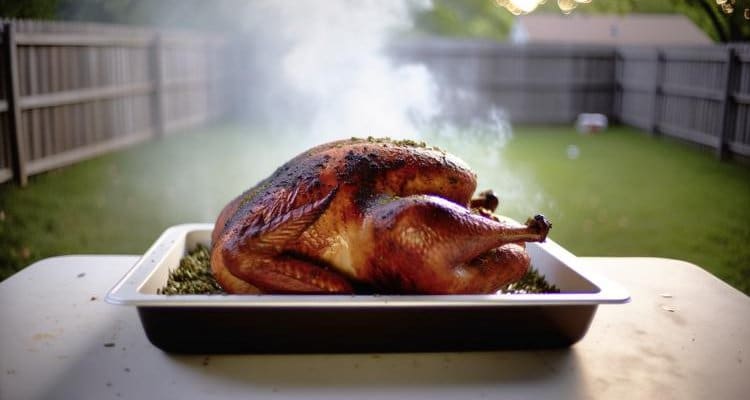
How to Smoke a Turkey: Complete Guide to Crispy Skin Perfection
This guide shows you how to smoke turkey from brine to carve, with the right wood, temp, and timing for juicy meat and perfectly crispy skin.

Smoked Pork Belly: The Low-and-Slow Recipe for Perfect Results
Master smoked pork belly with our tested recipe. Learn prep, seasoning, wood choice, and hitting 195°F for melt-in-your-mouth results every time.

Brisket Flat vs Point: Your Complete Butcher Counter Guide
See the full brisket flat vs point breakdown: fat content, cook times, and best uses for slicing, burnt ends, corned beef, or your very first brisket smoke.